|pt002|
Abbot Pedrosa Municipal Museum and International Museum of Contemporary Sculpture
Alvaro Siza, Eduardo Souto de Moura
Collaborators
Coordinators: José Carlos Nunes de Oliveira, Pedro Guedes Oliveira
Collaborators: Arq. Blanca Macarron, Diogo Guimarães, Ana Patrícia Sobral, Eva Sanllehí, Rita Amaral
Client
Câmara Municipal de Santo Tirso
Santo Tirso,
Portugal
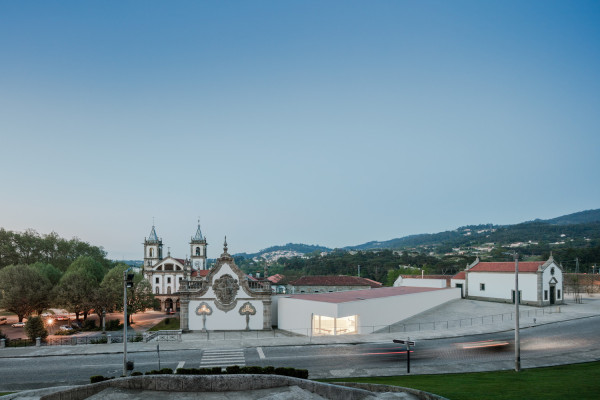
The design of the MIEC is determined by the monastery, whose lower edge marks the highest level that can be reached without interfering or rising above the historic building, with which it establishes a physical continuity. The two buildings are connected by an ‘arm’ that juts out of the main block, which required demolishing an annex, of scarce value, of the monastery. Defining the plaza of access to the new and to the old museum is the starting point, and from there the new building runs parallel to the existing wall to the north, generating an open space to the south by Unisco Godiniz Avenue. This arrangement creates a gentle transition between both buildings and that of Santo Tirso Misericordia – to the east –, which reconnects with the street, and also creates an emergency exit and brings sunlight into the exhibition spaces on level -1.
The adopted scheme is enhanced by the museum’s functional organization. From the main entrance, across from the old museum, visitors reach a lobby connecting the Abade Pedrosa Municipal Museum with the reception area and vertical accesses. The heights of the paved surfaces match those of São Bento Monastery.
The MMAP project is based on two principles: preserving the architectural features of the existing building by reinstating the elements that recover its original composition, and equipping it with the necessary structures for a good performance. An organization in four areas is proposed to achieve this: first, an intermediate space between the two museums with reception, ancillary services, and access to the technical zone on the roof; second, a corridor with an area for multimedia displays and access to all the museum’s rooms; third, a 56-seat auditorium with mobile furniture; fourth, seven connected exhibition galleries running parallel to the corridor, each with a glass display cabinet. These cabinets serve as exhibition elements, for storage, access to technical areas, and lighting support.
Original Use Religious
New Use Cultural, Religious
Build Date [2010 — 2016]